
The Machine-Payable Web: How HTTP 402 Came Back From the Dead
Jul 9, 2026
8 min Read
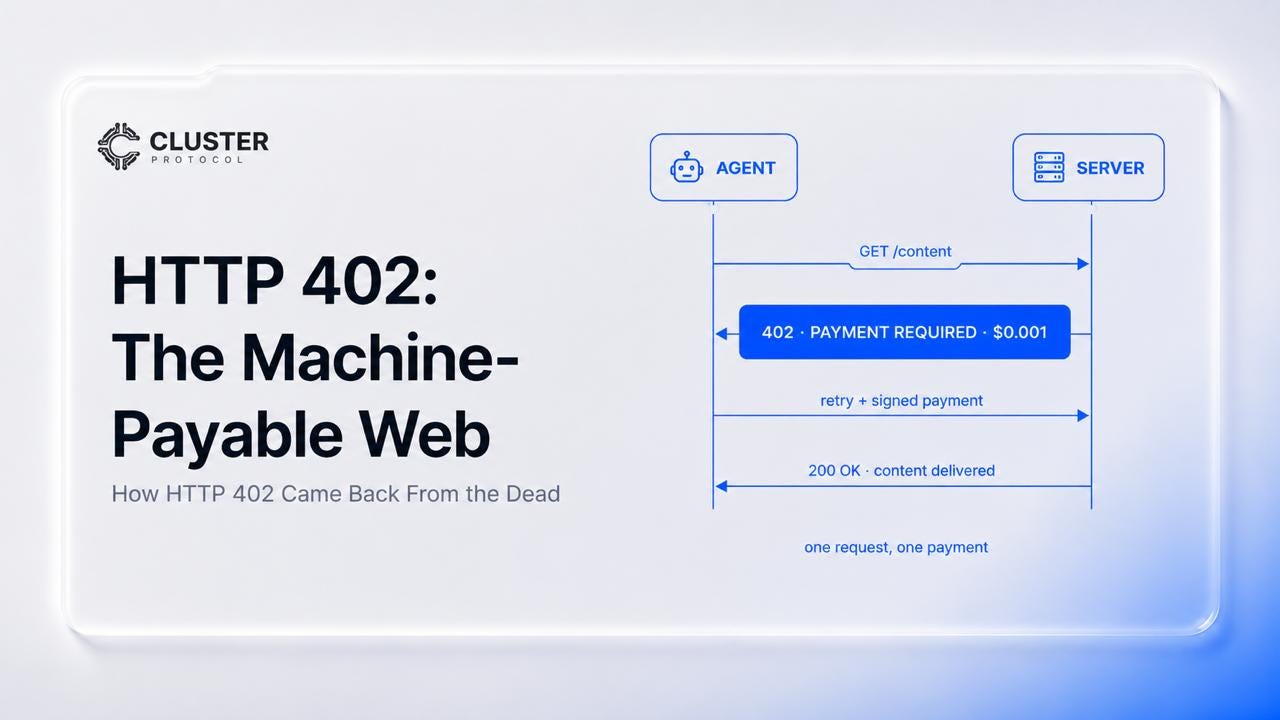
*A status code sat unused in the internet's source code for almost three decades. It is now the front door to a hundred-million-transaction economy where the customers are not human.. *
In 1997, the engineers writing the rules of the web reserved a status code called HTTP 402: Payment Required. It sat between 401 (you need to log in) and 403 (you are not allowed in). The official documentation said only one thing about it: *"reserved for future use."*
The future never seemed to arrive. The web chose a different business model. Content would be free, and attention would be the product. Advertising paid the bills, search engines sent the traffic, and everyone agreed not to look too closely at the deal.
For twenty-nine years, 402 did nothing.
Then the customers stopped being human.

The deal that broke
The old web ran on a simple trade. Publishers let crawlers read everything for free, because crawlers belonged to search engines, and search engines sent readers back. Readers saw ads. Ads paid for content. The loop closed.
AI broke the loop quietly, and then all at once.
An AI crawler does not send readers back. It reads your work once, folds it into a model or an answer box, and the reader gets what they need without ever visiting you. The traffic loop that funded the open web for two decades now leaks at exactly the point where the money used to flow in.
Publishers noticed. Cloudflare🔗, which sits in front of roughly a fifth of the web, heard the same request from news organizations and content owners over and over: *we do not want to block AI, we want to be paid by it.*
So Cloudflare reached into the internet's junk drawer and pulled out 402.
Pay-per-crawl: the web grows a price tag
Cloudflare's [pay-per-crawl](https://blog.cloudflare.com/introducing-pay-per-crawl/) system gives every domain owner three buttons for every AI crawler that shows up: allow it in free, block it entirely, or charge it a price you set per request.
When a crawler hits a paid page, the server answers with 402: Payment Required, and includes the price. The crawler can pay and proceed, or turn around and leave. No lawyers, no licensing negotiation, no email thread. The message, as Cloudflare describes it, is not "no", it is "yes, if"🔗, settled machine-to-machine in real time.

This stopped being a thought experiment some time ago. Stack Overflow partnered with Cloudflare🔗 on a pay-per-crawl model in early 2026, notable because Stack Overflow's two decades of programming Q&A is some of the most-scraped training material on earth. Mid-sized trade publications report $500 to $5,000 per month🔗 in crawler revenue, with premium archives earning much more. Not life-changing money yet. But it is the first time the open web has ever had a native meter.
The strategic point is bigger than the revenue. The web is repricing itself for machine readers. What was an all-you-can-eat buffet is becoming a menu, and the diners, crawlers, agents, automated researchers, arrive holding wallets.
Which raises the obvious question: what exactly do machines pay *with*?
x402: a payment rail with no humans in it
A crawler cannot type a credit card number. An autonomous agent cannot pass a KYC check, wait three days for a bank transfer, or click "I am not a robot" it would be lying.
This is the gap [x402](https://www.x402.org/) was built for. Launched by Coinbase in 2025 as an open standard, x402 takes the same 402 status code and turns it into a full payment handshake: a server quotes a price inside the HTTP response, the client attaches a signed stablecoin payment to its retry, and the request goes through. No account. No API key. No pre-deposited balance. No subscription. One request, one payment, settled on-chain in seconds.
The adoption curve is the kind you rarely see in infrastructure. According to [Chainalysis](https://www.chainalysis.com/blog/x402-agentic-payments-adoption/), x402 went from near zero in mid-2025 to over 100 million cumulative transactions on Base in roughly three quarters.

And the *shape* of those payments is changing in a way that tells you who is using it. In early 2025, transactions above $1 were [49% of x402 volume](https://www.chainalysis.com/blog/x402-agentic-payments-adoption/); by early 2026 they were 95%, while the 10-cents-to-a-dollar band collapsed from 46% to 4%. The rail is graduating from novelty pings to real commerce, agents buying data, compute, content, and services that cost real money.

The suits showed up
The clearest signal that machine payments are no longer a crypto side quest is who has plugged into them.
Visa added x402 support🔗 through its Trusted Agent Protocol. Stripe connected it through its Agent Commerce Protocol. And in May 2026, AWS launched Amazon Bedrock AgentCore Payments🔗, which lets agents discover, authorize, and execute x402 micropayments with built-in wallet management and policy-based spending controls. The largest cloud on the planet now ships agent wallets as a managed service.
Real merchants followed. In June 2026, travel platform Travala launched an end-to-end agentic booking flow🔗: an AI agent searches hotels, reserves a room, and settles payment over x402, with the human only approving at the end. Cloudflare itself published an open-source x402 template🔗 so any site can charge per download, per API call, or per crawl.
Twenty-nine years of silence, and then card networks, the biggest cloud provider, the biggest payments processor, and a fifth of the web all converged on the same dusty status code within eighteen months.
Notice also what these payments settle *in*: dollar-denominated stablecoins, not volatile assets. That detail is load-bearing. A machine buyer needs a unit of account that does not move between the quote and the retry, and a settlement asset that clears globally without a correspondent bank. Stablecoins on fast, cheap chains happen to be the only instrument that satisfies both constraints today, which is why the machine economy adopted them without a single conference panel debating it. The money question was settled by engineering requirements before anyone framed it as a currency choice.
Why subscriptions and API keys lose this fight
It is worth being precise about *why* this model wins for machine commerce, because the reasons are structural, not fashionable.
Subscriptions assume a relationship. A monthly plan makes sense for a human who uses a service habitually. An agent might need your API exactly once, at 3 a.m., for one query worth $0.30. Forcing it through signup, email verification, and a $29/month plan is how you get zero customers from the fastest-growing buyer category on the internet.
API keys assume an identity that machines struggle to carry safely. Keys get leaked, scraped, shared, and rate-limited. Every key is a standing liability that someone has to issue, store, rotate, and revoke. A signed per-request payment carries its own authorization, the money *is* the credential.
Card rails assume a fraud model built for humans. Chargebacks, 3-D Secure challenges, CAPTCHA walls, the entire stack exists to answer "is this a real person?" That is exactly the wrong question for a buyer that is proudly not a person. Machine commerce needs finality and programmability, not identity theater.
Per-request, stablecoin-settled, protocol-native payment is not a crypto preference. It is what the buyer's anatomy demands.
The unbundling that comes next
Follow the logic one step further and the implications get large.
If any URL can carry a price, then everything becomes an à la carte API. A single paragraph of premium research. One weather query. One inference call to a specialized model. One row of a dataset. The minimum viable product shrinks from "a platform with a pricing page" to "an endpoint with a price."
That dissolves the bundling logic the consumer internet was built on. Bundles existed because billing was expensive, nobody could meter a single article, so we sold subscriptions to a thousand of them. When metering costs effectively nothing, the bundle stops being a necessity and becomes a choice. Some bundles will survive on convenience. The rest unbundle into a long tail of machine-priced endpoints.
It also means the web splits into two audiences with two economies. The human web keeps its ads and subscriptions. The machine web, already the majority of traffic by several measures, runs on 402s and instant settlement. Same servers, same content, two completely different business models layered over each other.
The interesting question is no longer *whether* machines will pay their way. A hundred million transactions settled that. The question is what the machine economy's commerce layer looks like, and who runs its checkout.
The new math for anyone who publishes anything
If you run a site, an API, a dataset, or a model endpoint, the machine-payable web hands you a pricing question nobody had to answer before: *what is one request worth?*
The early answers are instructive. Cloudflare's design deliberately keeps it simple, a flat, per-request price across the domain🔗 because the first job is not optimization, it is existence: establishing that access has a price at all. The sophistication comes later, and you can already see its outline. Archives priced differently from fresh news. Structured data priced above prose. Bulk crawl discounts. Surge pricing when a model release sends every lab's crawlers hunting for evaluation data at once.
And because the buyers are machines, the sales channel is machine-legibility itself. A crawler deciding whether to pay your 402 does not read your About page; it reads your price, your terms, and the structure of what you serve. The publishers who win machine revenue will be the ones whose content is the easiest for software to evaluate and the cleanest to license, a discipline that looks less like SEO and more like product packaging for non-human customers.
There is a second-order effect worth naming, too. For twenty years, the ad-funded web optimized for one thing: keeping human eyeballs on pages longer. Entire genres of bloat, the recipe preceded by a memoir, the answer buried under eight paragraphs of preamble, exist because attention was the unit of monetization. When the marginal reader is a paying machine that wants the answer and nothing else, the incentive inverts. Dense, structured, verifiable content becomes the high-margin product. The 402 economy may quietly accomplish what two decades of reader complaints never did: make the web concise again.
The settlement layer is the moat
Here is the part most coverage misses: in this new economy, the scarce asset is not content, models, or even compute. It is settlement.
Every machine-payable interaction, a crawler paying a publisher, an agent buying inference, a workflow licensing a dataset, needs the same three things: a way to quote a price, a way to move value instantly, and a place where the books balance. Whoever provides that layer sits underneath every transaction the machine economy makes, the way Visa sat underneath the card economy.
This is the thesis behind unified AI infrastructure plays like Cluster Protocol🔗, which consolidates the three things agents actually buy, model inference, tokenized data, and compute, behind one API with x402 settlement native on Base. Instead of an agent juggling a dozen providers, a dozen keys, and a dozen invoices, intelligence, data, and money clear in one place, per request, with no accounts and no pre-funded balances. The machine-payable web needs machine-grade rails underneath it; the protocols that own that settlement layer own the toll booth.
The 402 status code waited twenty-nine years for its users to be born. They are here now, they are settling nine-figure transaction counts, and they have never once seen an ad.
The web's second business model is already running. Most people just have not gotten the status code yet.