
Private AI Inference without the Trust Assumption
Jul 20, 2026
7 min Read
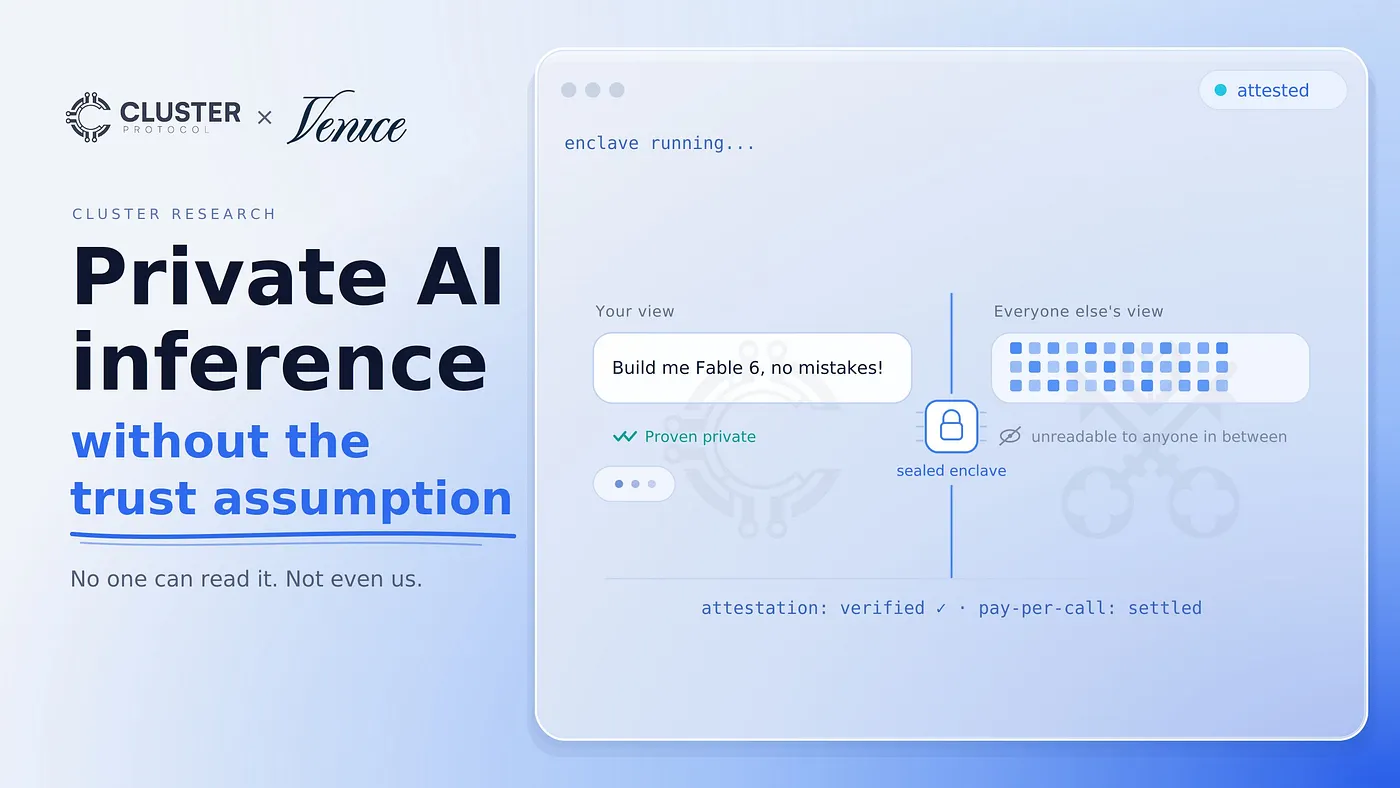
*Verifiable private inference finally makes AI confidential. Machine-native payments finally make it autonomous. The part worth paying attention to is what happens when you put the two on the same chain.*
Delete is a UI event, not a deletion
You told an AI something today that you would not say out loud. A symptom, an unreleased idea, a block of code that happens to be your employer’s crown jewel. That candor is the entire reason the tools are useful, and it is exactly what makes the next question uncomfortable: where does it go after you hit send.
The answer is not hypothetical. In the ongoing copyright case, a federal court ordered OpenAI to preserve all ChatGPT output logs, including chats users had explicitly deleted, and later ordered 20 million de-identified conversations produced to the plaintiffs🔗. Delete cleared your screen; it never controlled the servers. On the enterprise side, Samsung engineers leaked semiconductor source code, defect-detection code, and a meeting transcript into ChatGPT in three incidents inside 20 days🔗, and the company banned the tools outright. Both stories reduce to the same missing primitive: there was nowhere to send a prompt and *prove* it stayed private.
The plaintext moment nobody encrypts
Encryption already protects your data in two of its three states. In transit, TLS handles it. At rest, standard disk and database encryption handle it. The unsolved state is data *in use*: a language model cannot multiply its weights against your tokens while those tokens are still ciphertext, so for one unavoidable instant during inference your prompt has to exist as plaintext somewhere on someone else’s hardware. Every meaningful privacy guarantee in AI is really a claim about what happens in that instant.
Which sets up the only distinction that matters, and it is not open versus closed or centralized versus decentralized. It is trust-based versus verifiable. A privacy policy is a promise, and promises get overridden by court orders, rewritten in a terms update, or broken by a breach. A cryptographic proof does not care about any of that.
Five privacy tiers, only two are trustless
Privacy here is a spectrum, not a switch. Roughly weakest to strongest:
- **Anonymization:** A proxy strips identifying metadata before the request reaches the model, so the provider sees the content but not who sent it. Identity is protected; the content is not. Venice uses this for frontier models, [acting as a proxy so the provider never learns the user](https://venice.ai/blog/venice-launches-end-to-end-encrypted-ai).
- **Zero data retention: **The prompt is processed and nothing is persisted, no logs, no history. This is what shielded enterprise and ZDR API customers from the retention order above. It is real protection, but it is enforced by contract, meaning you are still trusting the operator to have actually deleted it.
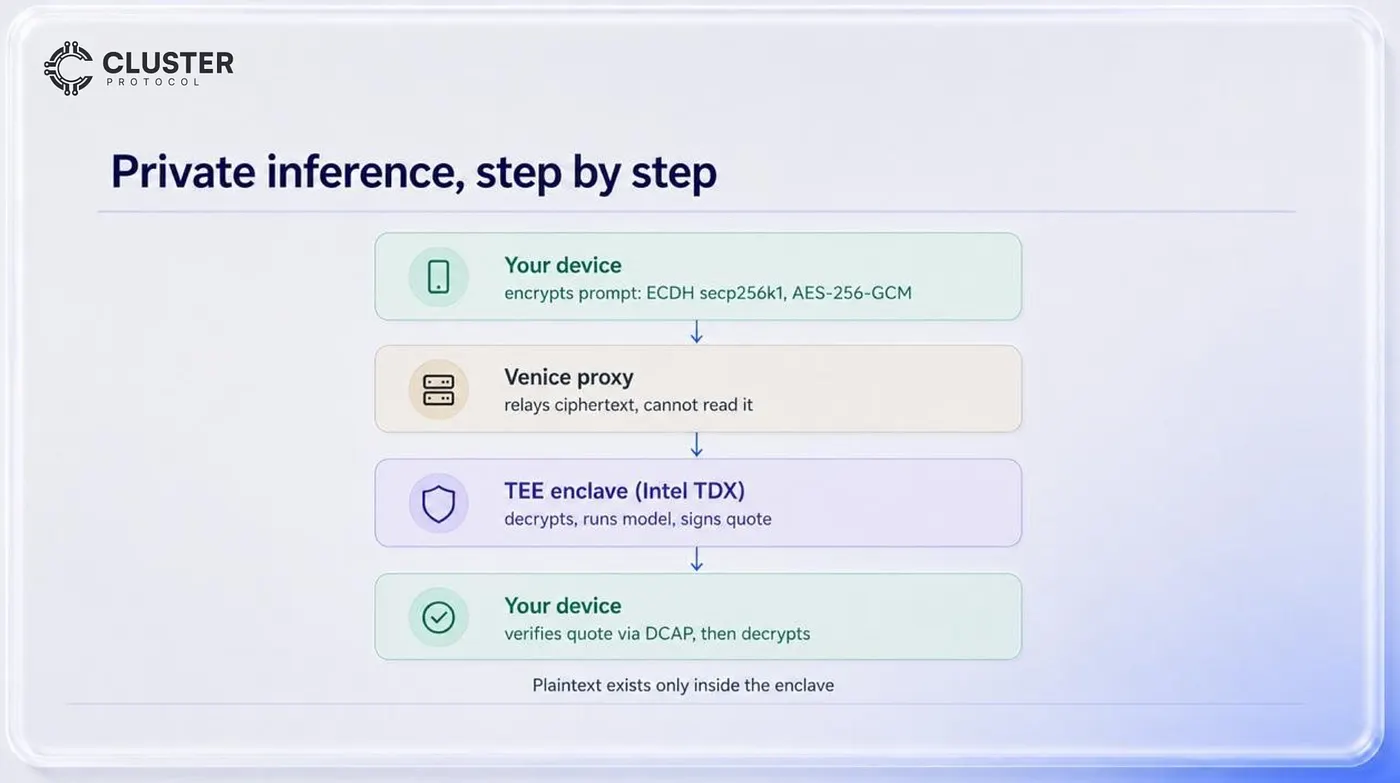
- **Trusted Execution Environment (TEE):** Inference runs inside a hardware enclave, an [Intel TDX or AMD SEV secure enclave that isolates the computation from the host OS, the hypervisor, and the infrastructure operator](https://phala.com/posts/venice-ai-phala-tee-verifiable-private-ai). Before the session starts, the CPU emits a *remote attestation report*, a certificate signed by the hardware’s own keys proving the code is running in a genuine enclave and has not been tampered with. This is the rung where privacy stops being a promise and becomes independently checkable. In Venice’s implementation, [the attestation panel surfaces TDX ECDSA-P256, the TDX certificate chain, and an NVIDIA GPU (NRAS) check that any external party can validate](https://www.theopensourcepress.com/venice-ai-launches-verifiable-end-to-end-encryption/), operated across [NEAR AI Cloud and Phala Network using Phala’s dstack framework](https://venice.ai/blog/venice-launches-end-to-end-encrypted-ai)
- **End-to-end encryption (E2EE):** The prompt is encrypted on your device and only decrypted inside the verified enclave, so not even the platform relaying it can read it. Venice’s open E2EE library shows the actual primitives: [ECDH over secp256k1 for key agreement and AES-256-GCM for the payload, with the plaintext only ever decrypted inside Intel TDX, plus DCAP quote verification (PCK certificate chain, TCB) and rejection of any enclave running in debug mode](https://github.com/elkimek/venice-e2ee) The honest tradeoff: features that need plaintext, like [web search and memory, are disabled in these modes](https://www.valuethemarkets.com/cryptocurrency/news/venices-new-encrypted-ai-interface-models-enhance-user-privacy)
- **Fully homomorphic encryption (FHE):** Computation directly on ciphertext, never decrypted. Cryptographically it is the endgame; practically it remains orders of magnitude too slow for real-time inference on large models. It is the frontier the field is aimed at, not the thing shipping at scale today.
The practical state of play: TEE and E2EE are live on real models today🔗, while most of the world is still transacting on the bottom two rungs without knowing higher ones exist.
Attestation is the gap between “won’t” and “can’t”
This is the same move crypto made with money. Do not trust the bank to keep an honest ledger; verify the chain. Attestation applies that logic to intelligence: you no longer trust the AI provider to keep your prompt private, you verify it could not read it even if it wanted to. Under TEE, the operator is removed from the trust equation for data in use; under E2EE, so is the platform itself. Trust does not disappear, it relocates, from a company’s policy to a hardware vendor’s silicon and a proof you can independently check.
Private inference still can’t take payment
Verifiable private inference solves confidentiality. It does not solve the fact that, increasingly, the thing running inference is not a person typing but an autonomous agent that needs to pay, per call, with no human in the loop to provision an account or API key.
That is what x402🔗 does, and it is worth understanding concretely because it is the settlement layer the rest of this depends on. The flow, for the standard “exact” scheme:
- The agent requests a paid endpoint; the server responds 402 Payment Required with a JSON envelope specifying scheme, network (CAIP-2, so eip155:8453 for Base), amount, asset, and recipient.
- The agent signs an [EIP-3009 transferWithAuthorization message](https://eco.com/support/en/articles/14839402-x402-protocol-explained), an EIP-712 typed payload of from, to, value, validAfter, validBefore, and a random nonce, and retries the request with the signature in a PAYMENT-SIGNATURE header.
- A facilitator submits transferWithAuthorization on the token contract, which verifies the signature via ecrecover, checks the nonce and time window, and executes a gasless USDC transfer on Base. The facilitator is only a broadcaster; it cannot alter the amount or destination.
No account, no card, no API key, settled in a single HTTP round trip. By April 2026 x402 had already carried roughly 165 million transactions across 69,000 agents at an average ticket near $0.30🔗. And it is not theoretical for private inference specifically: Venice already runs x402 across every endpoint, with a wallet-scoped signed payload, spending DIEM-backed balance first and falling through to USDC on Base, no account required🔗.
Where private inference meets its rails
So two primitives now exist in production, both live, both settling on Base: verifiable private inference with hardware attestation, and machine-native payment over HTTP. What is missing is the layer that composes them into autonomous workflows, and that is precisely the orchestration layer for autonomous workflows🔗 that Cluster is building.
Concretely, an orchestration layer is what lets you:
- **Route per step to the right privacy tier.** Sensitive steps that need attestation go to a TEE model; maximally secret self-contained steps go to E2EE; everything else routes to cheaper capacity. A single provider will never tell you to send a request elsewhere; an orchestrator’s whole job is to.
- **Treat the attestation as a settlement condition.** Because both the proof and the payment are cryptographic, the x402 settlement can be gated on a valid attestation quote, so an agent pays only when privacy is provably enforced rather than merely promised.
- **Compose private inference with data.** Pair a tokenized dataset from Cluster’s marketplace with Venice’s private inference: an agent buys access, reasons over it inside the enclave, and the data owner is paid through the same on-chain settlement, with neither the dataset nor the prompt exposed to a middleman.
The division of labor is clean. Venice is one of the strongest private-inference engines an orchestrator can route to. Cluster is the orchestration and settlement fabric around it. Both already speak x402 natively on the same chain, so they compose with no bespoke plumbing between them, and a prompt-to-deployment surface like CodeXero means that composition can ship as an actual application rather than staying an integration.
Privacy as the floor, not the upsell
The web spent three decades turning HTTPS from a luxury into the invisible floor, to the point that a browser now warns you when it is missing. Inference is at that same inflection, gaining a native payment layer and a native privacy layer at the same moment. The teams treating both as the substrate rather than a premium toggle are the ones that will still be standing after the next retention order or the next leak.
The most honest thing you did today deserves better than a promise. It deserves a proof.
Sources
- OpenAI, “How we’re responding to The New York Times’ data demands” (preservation of deleted logs; 20M-log production; ZDR and enterprise carve-outs) [https://openai.com/index/response-to-nyt-data-demands/](https://openai.com/index/response-to-nyt-data-demands/)
- Forbes, “Samsung Bans ChatGPT After Sensitive Code Leak” (three leak incidents in 20 days) [https://www.forbes.com/sites/siladityaray/2023/05/02/samsung-bans-chatgpt-and-other-chatbots-for-employees-after-sensitive-code-leak/](https://www.forbes.com/sites/siladityaray/2023/05/02/samsung-bans-chatgpt-and-other-chatbots-for-employees-after-sensitive-code-leak/)
- Venice, “Venice Launches End-to-End Encrypted AI” (TEE and E2EE modes; NEAR AI Cloud and Phala; proxy for frontier models) [https://venice.ai/blog/venice-launches-end-to-end-encrypted-ai](https://venice.ai/blog/venice-launches-end-to-end-encrypted-ai)
- Phala, “Phala Partners with Venice AI to Deliver Verifiably Private AI” (Intel TDX / AMD SEV enclaves; remote attestation signed by CPU keys; dstack) [https://phala.com/posts/venice-ai-phala-tee-verifiable-private-ai](https://phala.com/posts/venice-ai-phala-tee-verifiable-private-ai)
- The Open Source Press, “Venice AI Launches Verifiable End-to-End Encryption” (attestation panel: TDX ECDSA-P256, NVIDIA NRAS; supported models; Pro tier) [https://www.theopensourcepress.com/venice-ai-launches-verifiable-end-to-end-encryption/](https://www.theopensourcepress.com/venice-ai-launches-verifiable-end-to-end-encryption/)
- venice-e2ee library (ECDH secp256k1, AES-256-GCM, DCAP verification, debug-mode rejection) [https://github.com/elkimek/venice-e2ee](https://github.com/elkimek/venice-e2ee)
- Value the Markets, “Venice’s New Encrypted AI Interface Models” (web search and memory disabled under TEE/E2EE) [https://www.valuethemarkets.com/cryptocurrency/news/venices-new-encrypted-ai-interface-models-enhance-user-privacy](https://www.valuethemarkets.com/cryptocurrency/news/venices-new-encrypted-ai-interface-models-enhance-user-privacy)
- Crypto Briefing, “Venice rolls out end-to-end encrypted AI modes” (transit-through-proxy caveat; live status) [https://cryptobriefing.com/encrypted-ai-inference-venice-release/](https://cryptobriefing.com/encrypted-ai-inference-venice-release/)
- Coinbase, x402 v2 specification (402 envelope; exact scheme; EIP-3009; facilitator interface) [https://github.com/coinbase/x402/blob/main/specs/x402-specification-v2.md](https://github.com/coinbase/x402/blob/main/specs/x402-specification-v2.md)
- Eco, “x402 Protocol Explained” (EIP-3009 transferWithAuthorization mechanics; EIP-712 fields) [https://eco.com/support/en/articles/14839402-x402-protocol-explained](https://eco.com/support/en/articles/14839402-x402-protocol-explained)
- Eco, “Pay-per-Call APIs for AI Agents” (adoption: ~165M transactions, 69k agents, ~$0.30 average ticket by April 2026) [https://eco.com/support/en/articles/14846274-pay-per-call-apis-for-ai-agents](https://eco.com/support/en/articles/14846274-pay-per-call-apis-for-ai-agents)
- Venice, “x402 is Live on Venice” (x402 across all endpoints; DIEM-first then USDC on Base; no account) [https://venice.ai/blog/venice-now-supports-x402](https://venice.ai/blog/venice-now-supports-x402)