
MCP, A2A, x402: The Open Stack Nobody Owns
Jun 27, 2026
9 min Read
*Every transformative network in history had the same inflection point , the moment its plumbing standardized. The internet had it in the early 1990s. The agent economy is having it right now, and most people are watching the models instead of the protocols.*
In 1993, the smartest money in technology was betting on walled gardens. CompuServe, AOL, Prodigy: polished, proprietary online services, each convinced that the future of networking was their network, with their content, behind their login.
The future disagreed. It arrived as a stack of unglamorous open protocols, TCP/IP to move packets, HTTP to serve documents, SMTP to carry mail, that nobody owned, anybody could implement, and everybody could build on without permission. The walled gardens did not lose because their products were bad. They lost because proprietary networks compete; open protocols compound. Every new website made the open web more valuable to every other website. No corporate roadmap can outrun that math.
Thirty years later, the same fork in the road has appeared, except this time the nodes are not computers. They are AI agents. And the protocol stack that will wire them together is being assembled, piece by piece, in public, right now.
Three protocols matter most. One teaches agents to use tools. One teaches them to talk to each other. One teaches them to pay. Together they are doing for machine intelligence what TCP/IP did for machines: turning isolated systems into an economy.
MCP: how agents touch the world
Start at the bottom of the stack. A language model, alone, is a brain in a jar, brilliant, and unable to do anything. Every useful agent needs hands: access to files, databases, APIs, calendars, codebases, browsers.
Until late 2024, every one of those connections was a bespoke integration. N models times M tools meant N×M custom adapters, the same combinatorial swamp that pre-standard networking drowned in.
The Model Context Protocol (MCP), introduced by Anthropic in November 2024, collapsed that swamp with one move: a standard interface through which any AI system can discover and use any tool that speaks the protocol. Practitioners immediately reached for the right metaphor: the USB-C of AI. Build a tool server once; every MCP-speaking agent on earth can plug into it. N×M became N+M.
Adoption followed the pattern open standards always follow when they solve a real pain: quietly, then everywhere. By 2026, MCP servers exist for databases, design tools, cloud platforms, and consequentially, money. In May 2026, Coinbase shipped Base MCP, connecting AI assistants directly to onchain wallets; cross-chain systems like deBridge’s MCP let agents quote and execute swaps across two dozen networks. The jar is open. The brain has hands.
A2A: how agents find each other
Hands are not enough. The interesting economics start when agents stop working alone.
A travel agent that books your trip is a tool. A travel agent that negotiates with an airline’s pricing agent, coordinates with your calendar agent, and instructs a payments agent is a participant in a market. That requires a shared language for discovery, capability exchange, and long-running collaboration between agents built by different companies on different stacks.
That is the job of Google’s Agent-to-Agent protocol (A2A), launched in 2025 with a large coalition of enterprise backers: a vendor-neutral way for agents to advertise what they can do, request work from each other, and manage tasks that take minutes or days. Where MCP is the agent’s hands, A2A is its diplomatic corps, the difference between software that uses things and software that deals with counterparties.
The pairing matters strategically. MCP and A2A are complements, not rivals, one vertical (agent to tools), one horizontal (agent to agent) and both are open. The agent internet’s nouns and verbs are being standardized outside any single company’s walled garden, which is precisely what did not happen in social networking, and precisely why social networking became five fortresses instead of a commons.
x402: how agents settle up
Now the layer the first internet never got and paid for dearly.
The web’s founders left payments out of the stack. HTTP even reserved a status code for it, 402: Payment Required that sat dormant for nearly three decades. Into that vacuum rushed advertising, the business model of last resort, and with it surveillance, clickbait, and the attention economy. The web monetized eyeballs because it had no way to monetize requests.
Agents cannot pay with eyeballs. They do not see ads, hold credit cards, or pass CAPTCHA tests honestly. If the agent economy was going to have commerce at all, it needed payments in the protocol layer and that is exactly where they landed. x402, launched by Coinbase as an open standard, resurrects the dormant status code into a complete machine-payment handshake: server quotes a price in the HTTP response, agent retries with a signed stablecoin payment, settlement lands onchain in seconds. No account, no API key, no subscription, no human.
The traction has been the steepest of the three protocols: over 100 million transactions on Base within three quarters, with the transaction mix shifting sharply toward real-money payments. More telling, the incumbents bridged to it rather than against it, Visa through its Trusted Agent Protocol, Stripe through its agentic commerce stack, and AWS through Bedrock AgentCore Payments, which ships agent wallets with policy controls as a managed cloud service.
The first internet bolted payments on twenty years late and got surveillance capitalism in the interim. The agent internet is installing them at layer zero. That single difference will shape everything built above it: the default business model of the machine web is not attention. It is metered exchange.
It is worth pausing on why this layer settled on crypto rails rather than the banking system, because the answer is anatomical, not ideological. An agent cannot open a bank account, account opening is a legal act reserved for persons. It cannot hold a card in its own name, pass a liveness check, or wait two days for ACH. What it can do is hold a key pair and sign messages. Public blockchains are, among other things, the only financial infrastructure on earth where a key pair is a first-class account holder, no onboarding, no paperwork, programmable by default, final in seconds. The machine economy did not choose crypto out of conviction. It chose the only settlement system whose minimum viable participant is software.
The loop closes
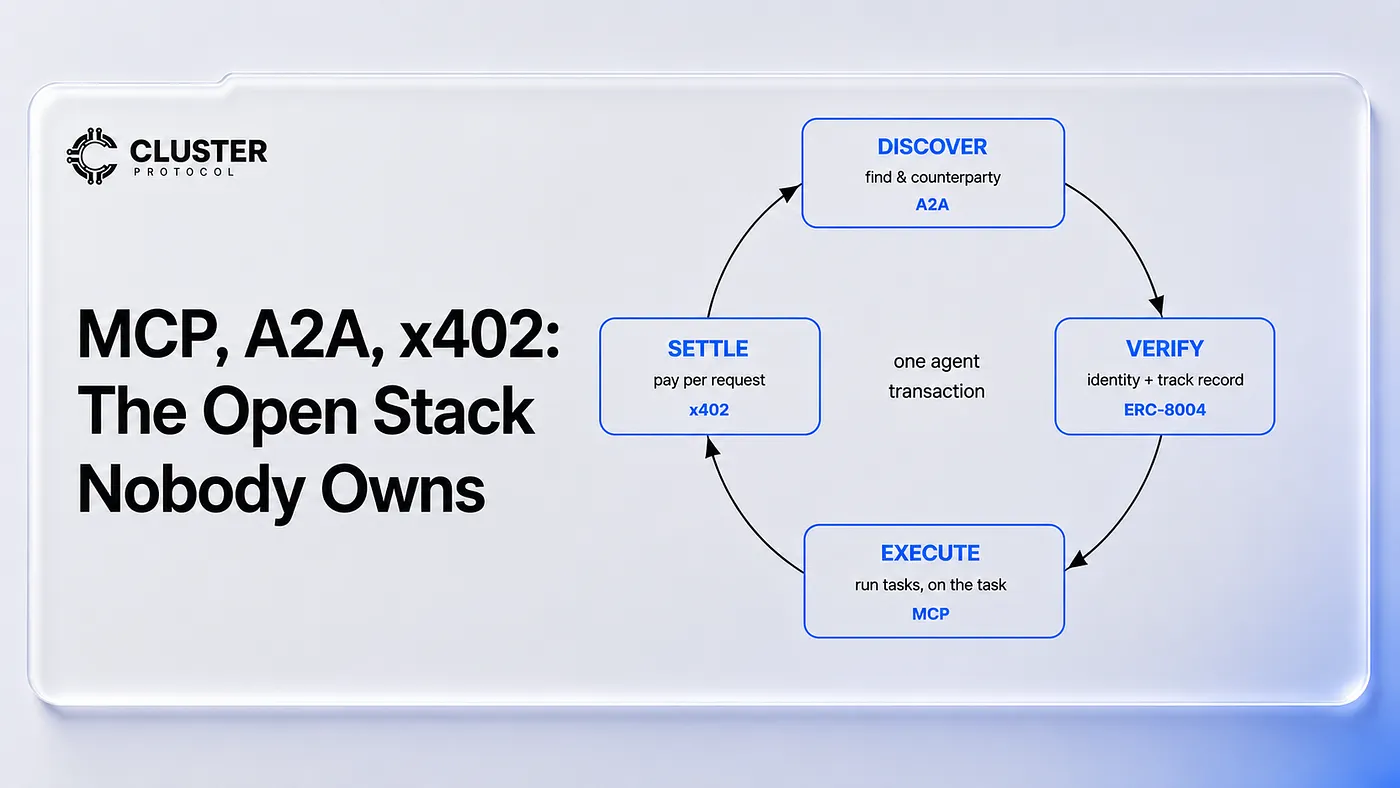
Add the trust layer, agent identity registries like ERC-8004, live on Ethereum mainnet since January🔗, giving agents portable identity, reputation, and third-party validation, and the full transaction loop of a machine economy now exists end to end, every link an open standard:
An agent discovers a counterparty and its capabilities (A2A). It verifies who built it and how it has behaved (ERC-8004). It negotiates the task (A2A again). It executes, reaching into whatever tools the job requires (MCP). And it settles, per request, machine to machine (x402).
Stare at that loop and the TCP/IP analogy stops being a metaphor and becomes a checklist. Interoperable transport? Check. Shared application semantics? Check. Identity and trust? Check. Native settlement? Check, the one box the human web never ticked.
History says what happens when a loop like this closes: composability ignites combinatorics. The web’s explosion was not planned by the protocol authors; browsers, search engines, marketplaces, and social networks were all unanticipated permutations of open pieces. The agent economy’s equivalents, swarms of specialized agents assembling supply chains of intelligence on demand, paying each other per call, will be built by people recombining MCP, A2A, x402, and identity in ways none of their designers predicted. The protocols are the periodic table; the chemistry has barely started.
What could still break it
Protocol optimism deserves its stress test, because open stacks have been strangled before. Three risks are worth watching honestly.
Embrace, extend, extinguish. The classic play: an incumbent adopts the open standard, becomes its dominant implementation, then adds proprietary “improvements” until interoperability quietly dies. The 1990s browser wars ran exactly this script. The early warning sign in the agent stack would be platform-specific MCP extensions or A2A dialects that only work inside one vendor’s walls, open protocol as marketing, closed network as practice.
Standards capture. A protocol’s governance is its constitution. A2A carries a large corporate sponsor; x402 was incubated by an exchange; even community standards can be steered by whoever staffs the working groups. The defense is the one Ethereum’s process demonstrated with ERC-8004: specification in public, implementations plural, and no single party able to revoke what is already deployed on neutral infrastructure.
The convenience trap. The most realistic threat is not malice but UX. Walled gardens win when integration friction makes the closed path meaningfully easier, AOL did not need to sabotage the open web in 1994; the open web was simply harder to use. The agent stack avoids that fate only if composing MCP, A2A, identity, and x402 becomes a one-afternoon task rather than a systems-integration project. Which, notably, is an infrastructure problem, not a protocol problem, and infrastructure is where that fight will be decided.
None of these risks argues against the stack. They argue for vigilance about *where its chokepoints form,* because every open protocol economy still develops them, one layer up, in whoever operates the venues demand actually flows through.
The missing layer is the marketplace
One thing protocols deliberately do not provide: a *place*. TCP/IP moved packets; someone still had to run the servers, host the content, and operate the markets. Open standards create the possibility of an economy. Infrastructure operationalizes it.
Look at the loop again and ask the practical question: when an agent executes and settles, *what is it actually buying?* Overwhelmingly, three things, model inference, data, and compute. The raw materials of machine cognition. In today’s fragmented market, those live behind dozens of providers, dozens of authentication schemes, dozens of billing relationships, the exact N×M swamp MCP drained at the tool layer, reborn at the resource layer.
That is the gap unified infrastructure like Cluster Protocol🔗 is built to fill: the protocol stack’s *marketplace floor,* 500+ models, tokenized datasets, and compute behind one API, with x402 settlement native on Base, so the open-protocol loop terminates somewhere that speaks its language at every step. In the protocol economy, the scarce position is not owning a standard, nobody owns TCP/IP, it is operating the venue where standardized demand meets supply. The 1990s proved both halves: the protocols stayed free, and the companies that ran the best rails on top of them defined the next thirty years.
The walled-garden agent platforms will be excellent, the way AOL was excellent. They will curate, polish, and protect. And they will lose the same way, to the same force: a stack nobody owns, compounding daily, wiring together intelligence the way the last open stack wired together humanity.
In 1993, the people who saw it coming were not the ones admiring the online services’ interfaces. They were the ones reading RFCs. The equivalent documents are public again, protocol specs, registry contracts, settlement standards, and they are telling the same story they told last time, to anyone willing to read plumbing instead of demos.
The packets have learned to think. The protocols just taught them to trade.
Sources
- [SubQuery: Vibe Coding Meets AI (MCP as connective tissue)](https://subquery.medium.com/vibe-coding-meets-ai-the-future-of-blockchain-indexer-creation-59854cfb33cd)
- [The Crypto Times: Coinbase Pushes AI-Crypto Fusion With New Base MCP Tool](https://www.cryptotimes.io/2026/05/26/coinbase-pushes-ai-crypto-fusion-with-new-base-mcp-tool/)
- [deBridge: How AI Agents Trade Crypto in 2026](https://debridge.com/learn/guides/how-ai-agents-trade-crypto-in-2026/)
- [Kibo Commerce: Understanding Agent-Driven Commerce (A2A, AP2)](https://kibocommerce.com/blog/understanding-agent-driven-commerce/)
- [x402.org: Internet-Native Payments Standard](https://www.x402.org/)
- [Chainalysis: Inside x402: 100M Agentic Payments on Base](https://www.chainalysis.com/blog/x402-agentic-payments-adoption/)
- [AWS: x402 and Agentic Commerce](https://aws.amazon.com/blogs/industries/x402-and-agentic-commerce-redefining-autonomous-payments-in-financial-services/)
- [Eco: ERC-8004: Trustless Agent Identity](https://eco.com/support/en/articles/14730445-erc-8004-trustless-agent-identity)