
Cluster x Mind Network: Confidential Payments for Autonomous Agents
Jul 3, 2026
3 min Read
Every payment an AI agent makes through an open standard like x402 is visible onchain. Sender, receiver, token, amount, all public, all permanent. For a consumer agent buying an API call, that transparency is fine. For a business running agents that move real value, it is a dealbreaker. Competitors can read your flows, counterparties can see your volumes, and a compliance team cannot sign off on financial data that is exposed by default.
Cluster’s agents transact through x402. Mind Network is building the layer that lets them do it privately.
What Mind Network brings
Mind Network builds privacy and trust infrastructure for the machine economy. Its core technology is Fully Homomorphic Encryption, which allows computation to run on encrypted data without ever decrypting it, so data, transactions, and agent interactions can stay encrypted across their entire lifecycle.
Its latest initiative, x402z, extends Coinbase’s x402 payment standard with confidential payments for AI agents. An agent can make a verifiable payment and prove compliance without revealing the sensitive financial or behavioral data behind it.
The integration: same rail, privacy added
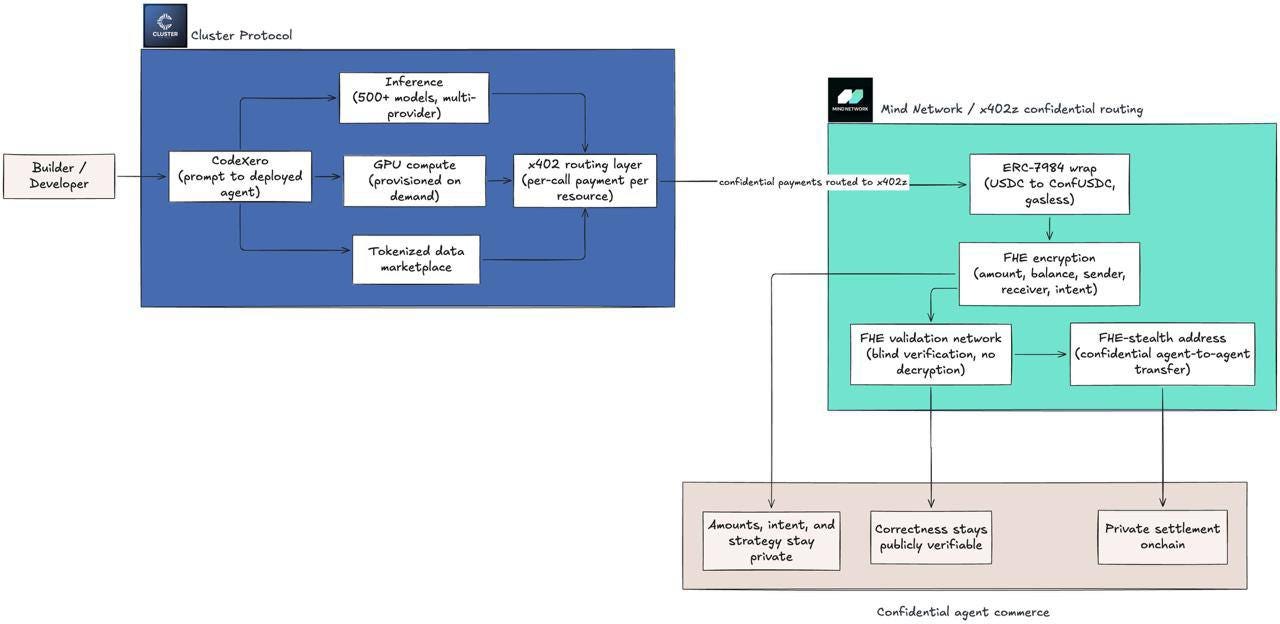
This is the clean part. Cluster’s agents already pay per call through x402, in USDC on Base, with no accounts and no API keys. x402z is a confidentiality layer over that same standard. The agent still transacts on x402. x402z encrypts the details that should not be public, the sender, receiver, token type, and amount, while keeping the payment verifiable and auditable where it needs to be.
Nothing about the developer experience changes. An agent built on CodeXero and funded through x402 gains the option to transact confidentially by routing through x402z.
No new payment stack to learn, no rebuild. x402z sits over x402 as an option, not a replacement.
Why private agent payments matter
The point is not privacy for its own sake. It is what privacy unlocks for three different groups.
For developers, privacy stops being something you engineer yourself and becomes a setting you turn on. For users, an agent acting on your behalf no longer broadcasts your financial behavior to anyone watching the chain. For enterprises, this is the missing piece for agentic commerce at scale. A business can deploy agents that transact securely, preserve confidentiality, and still meet regulatory requirements, three things that rarely coexist in onchain payments today.
That enterprise case is the one worth sitting with. Plenty of teams can move value onchain. Very few can do it privately and provably at the same time, which is exactly what a regulated business needs before it will let an agent touch real money.
What we are exploring together
This is early, and we would rather be straight about that than oversell it. Cluster and Mind Network are exploring how confidential agent payments should work in practice: what developers actually need, and how to make private transactions simple enough that people use them by default rather than as a special case.
The direction is clear, agents built on Cluster, funded through x402, and made private through x402z. Built, funded, and confidential on one stack.
About Mind Network
Mind Network builds privacy and trust infrastructure for the machine economy, using Fully Homomorphic Encryption to keep data, transactions, and AI agent interactions encrypted throughout their lifecycle. Its x402z initiative extends the x402 payment standard with confidential payments for AI agents, and its broader work spans confidential AI, private cross-chain transactions, encrypted identity, secure messaging, and institutional-grade blockchain applications.
About Cluster Protocol
Cluster Protocol is the unified Private AI infrastructure layer on Base, serverless inference across 500+ models, a tokenized data marketplace, and GPU compute provisioning under a single API and a single native token.
With x402 payment rails, AI agents can pay for inference autonomously without accounts or API keys. CodeXero, the application layer, lets anyone deploy fully on-chain applications from a natural language prompt.