
500+ Models, 50+ APIs, Zero Settlement: Why AI Needs Its Amazon Moment
Jul 23, 2026
8 min Read
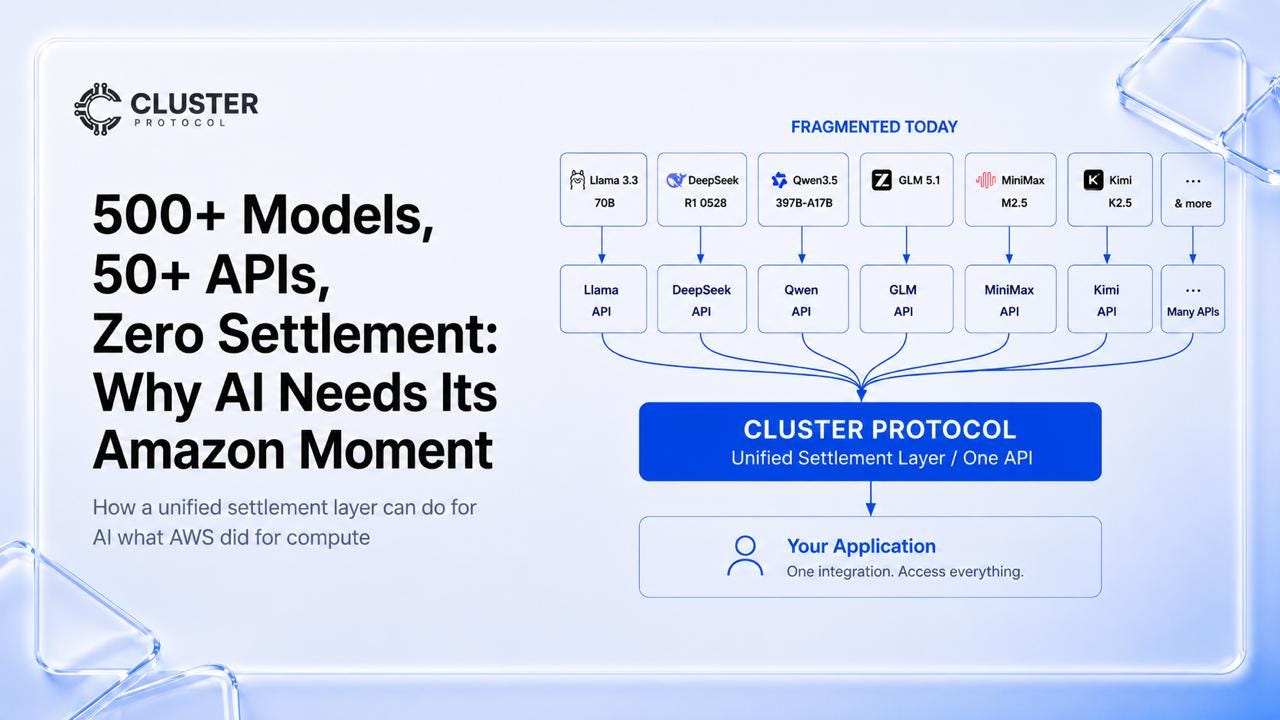
*Two decades ago, computing infrastructure was a fragmented mess of server rooms, procurement cycles, and bespoke contracts, until one API collapsed it into a utility. AI infrastructure in 2026 is the same mess, one layer up. The collapse is overdue.*
There is a particular kind of chaos that precedes every great consolidation in technology.
Before Amazon, online retail was ten thousand storefronts, each with its own checkout, its own shipping logic, its own trust problem. Before AWS, getting a server meant capital expenditure, a procurement committee, and a six-week lead time, per company, per project, forever. The pattern is always the same: a layer of the economy fragments faster than anyone can integrate it, the integration tax becomes the dominant cost, and then someone abstracts the whole layer behind a single interface.
Jeff Bezos called the underlying work “undifferentiated heavy lifting” the toil every company performed identically and none gained an edge from. AWS’s insight was not technical brilliance. It was accounting: take the heavy lifting everyone duplicates, do it once behind an API, and meter it.
Now look at AI in 2026 and try not to see the same pre-collapse chaos.
The fragmentation nobody planned
The AI stack a serious team touches today is not a stack. It is a sprawl.
Models sprawled. The “one model to rule them all” era lasted about eighteen months. Today there are hundreds of competitive models, frontier generalists, fast cheap workhorses, code specialists, image and audio and embedding models, rerankers, open-weight fine-tunes and the honest engineering consensus is that [no single model wins across tasks](https://www.kucoin.com/blog/deep-dive-to-AI-crypto-future). Cost-quality frontiers shift monthly. The optimal strategy is routing: cheap model for the easy 80%, frontier model for the hard 20%, specialist where it matters. Which means every serious product is now, structurally, a *multi-model* product.
APIs sprawled with them. Every provider ships its own API shape, its own SDK quirks, its own authentication, its own rate limits, its own outage calendar, its own deprecation schedule. Teams maintain adapter layers, fallback chains, and key-rotation ceremonies across a dozen vendors. The industry even grew a name for the coping mechanism, model routers and gateways, which is what an ecosystem builds when the fragmentation has won.
And billing never unified at all. This is the quietly absurd part. A multi-model product means a dozen billing relationships: a dozen dashboards, a dozen pre-funded balances or credit cards on file, a dozen invoices marching through accounts payable, a dozen pricing models changing under you. Twelve meters, twelve bills, zero consolidation.
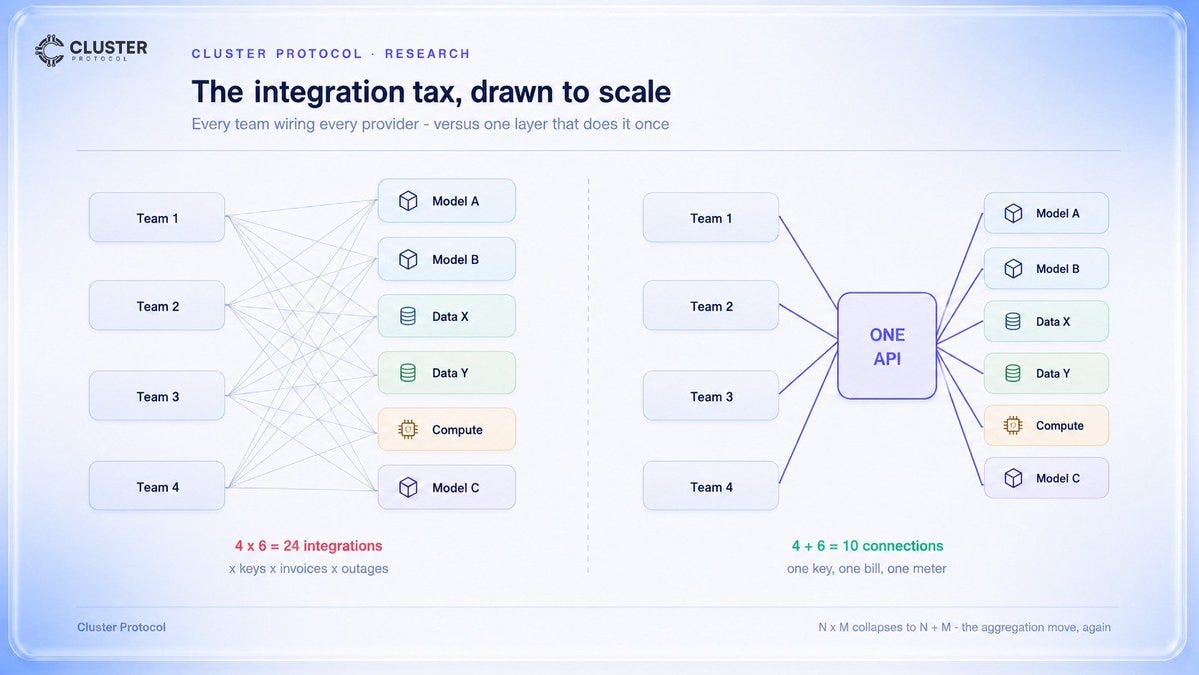
Add the other two resource layers and the picture completes itself. Data: scattered across silos and brokers, sold through bespoke licensing deals measured in hundreds of millions🔗 for those big enough to negotiate, inaccessible to everyone else. Compute: a landscape of clouds and clusters with wildly divergent pricing and availability.
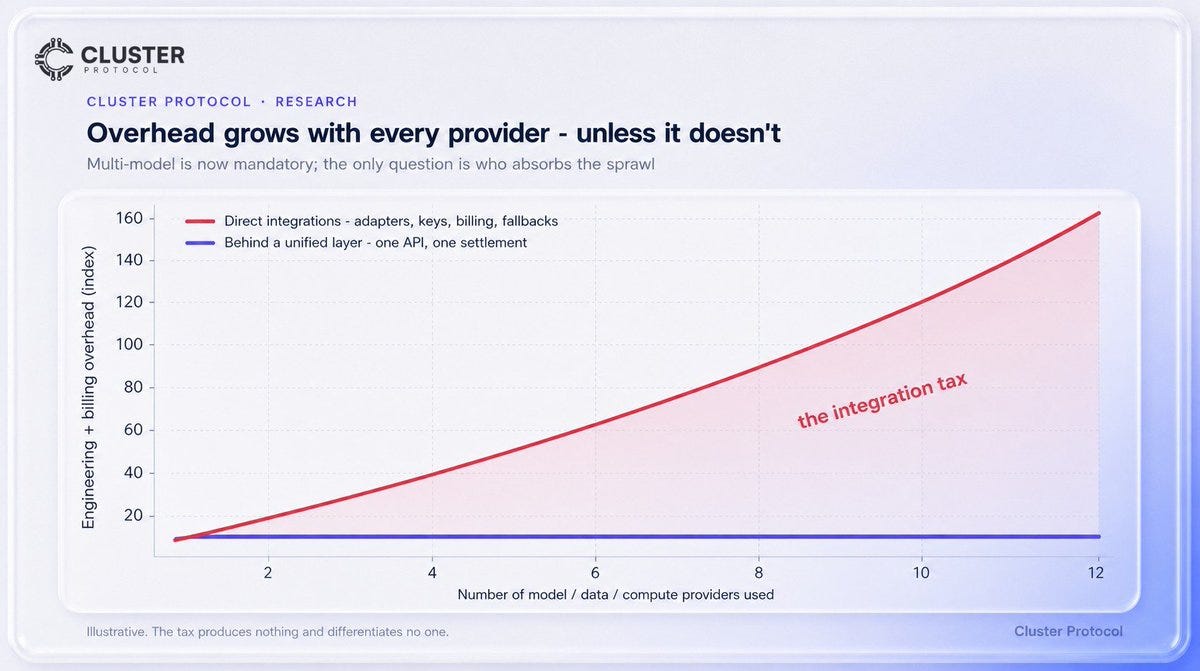
Three resources: intelligence, data, computation. Every AI application needs all three. No common interface, no common market, no common settlement. The integration tax is now the largest unproductive line item in applied AI. It produces nothing. It differentiates no one. It is 2005’s server room, rebuilt in software.
Why settlement is the missing half
Most aggregation attempts in AI fixate on the API problem, normalize the request shape, route the call. Useful, but it solves the easy half. The half nobody solved is settlement, and it is about to become the binding constraint, for one reason: the fastest-growing consumer of AI infrastructure is no longer a developer with a credit card. It is an agent with a budget.
Autonomous agents are voracious, bursty, opportunistic buyers. An agent pipeline might need one embedding call, three cheap inferences, one frontier reasoning call, a dataset lookup, and thirty seconds of compute, across five providers, in four seconds, once, at 3 a.m. Now run that purchasing pattern through the human-era stack: five accounts the agent cannot open, five API keys someone must provision and guard, five pre-funded balances trapping working capital, five invoices for a transaction worth eleven cents.
It does not work. It *cannot* work, accounts, keys, and invoices assume a standing relationship between two companies, and agentic demand is relationship-free by nature. Machine buyers need machine settlement: price quoted in the protocol, payment attached to the request, finality in seconds, no membership required.
That rail now exists. x402🔗, the HTTP-native payment standard revived from the web’s dormant 402 status code, settled over 100 million transactions on Base in its first three quarters🔗, with Visa, Stripe, and AWS🔗 all bridging into it. Per-request payment with no accounts is no longer speculative; it is the fastest-growing settlement pattern on the internet.
But a payment rail alone is a road without destinations. The question that decides the next market structure is: where does standardized machine demand go to buy?
The shape of the Amazon moment
History gives the spec sheet. Every layer-collapse follows the same blueprint, and AI’s version is legible if you hold the AWS playbook up against it.
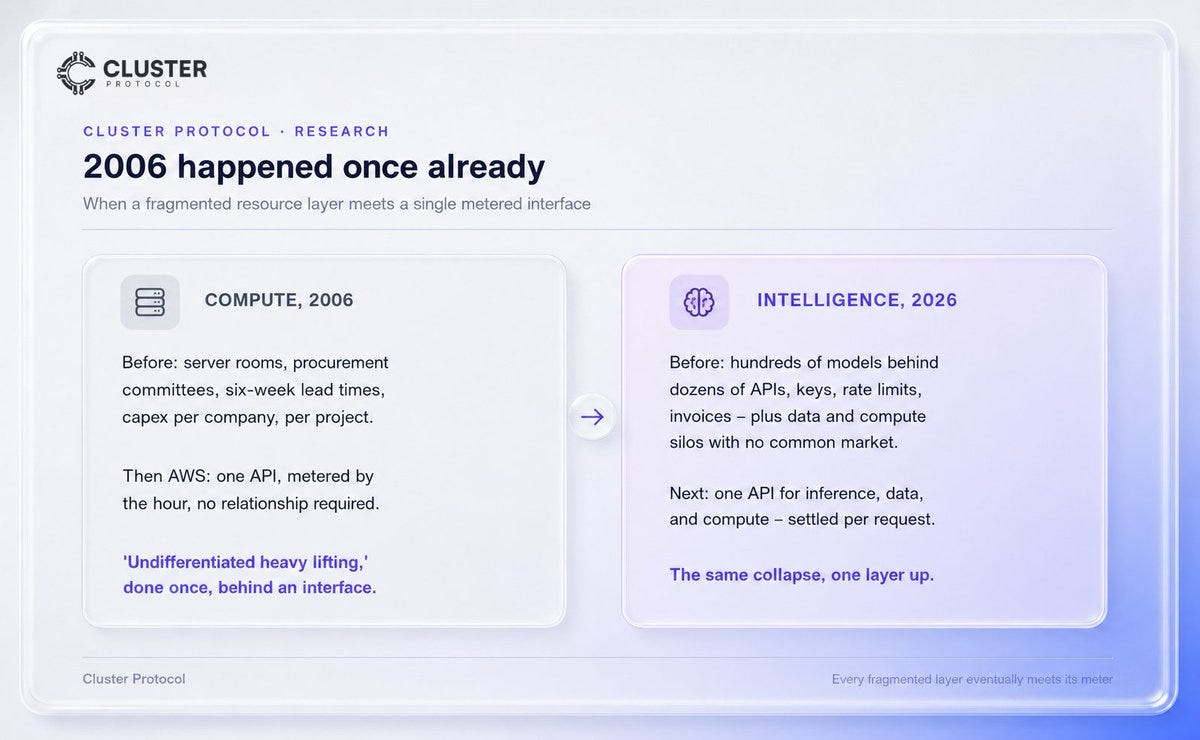
One interface over fragmented supply. AWS did not manufacture better servers; it abstracted servers. The AI equivalent: one API over hundreds of models across every modality: text, image, audio, embeddings, reranking, so switching models becomes a parameter change, not a migration. Supply keeps fragmenting upstream (good, fragmentation upstream is competition), while demand integrates downstream.
Metered, relationship-free consumption. AWS replaced procurement with a meter. The AI equivalent goes further, because its buyers include software: per-request pricing settled at the protocol layer, x402-native, no accounts, no pre-deposits, no invoice march. The meter *is* the business relationship.
All three resources in one venue. Amazon’s retail flywheel worked because everything was in one cart. The AI equivalent: inference, data, and compute purchasable in the same place, against the same settlement layer: because real workloads consume all three together, and the integration tax lives precisely in the seams between them.
The economics flip from lock-in to routing. Here is the part incumbents will resist: in a unified market, providers compete *per request*. Aggregation theory’s lesson is that when demand concentrates behind one interface, power shifts from whoever controls supply to whoever owns the demand relationship and supply is forced to compete on price and quality every single call. The integration tax does not just shrink; it converts into routing surplus for the buyer.
The objections, taken seriously
“Aggregators just become the new monopolist.” The AWS-shaped risk is real, which is why it matters *where* the aggregation layer settles. An aggregator whose billing is proprietary owns you; an aggregator settling over an open protocol on a public chain is replaceable plumbing, disciplined by the credible threat of exit. Open settlement is the structural difference between a utility and a landlord.
“Frontier labs will never commoditize.” They do not need to. The frontier stays premium and differentiated; aggregation wins the *workload*, not the crown. The overwhelming majority of inference demand is price-sensitive routine work where routing beats loyalty, and that majority is where margins and volume live, exactly as the boring EC2 instance, not the exotic hardware, built AWS.
“An extra hop must cost latency and quality.” Measured against what? A unified layer adds routing overhead measured in milliseconds; the fragmented alternative costs weeks of integration per provider, plus the permanent quality tax of *not switching,* staying on yesterday’s model because migration is painful. Routing layers pay their few milliseconds and buy continuous access to whichever model currently tops the cost-quality frontier. In a market where the frontier moves monthly, the ability to follow it is worth more than the hop costs. The slow path is not the gateway; the slow path is the lock-in.
“This already exists, there are model routers.” Partially, and the partial version proves the demand. But routers without settlement unification solve syntax while leaving the economics broken; gateways without data and compute solve one resource of three. The Amazon moment is not “a nicer API.” It is the collapse of *interface, market, and settlement* into one layer. Nobody reached it yet at full depth, which is what makes it a moment rather than a feature.
What open settlement unlocks that a billing page can’t
There is one more difference between this consolidation and 2006’s, and it is the one that changes the business models built on top.
AWS unified compute behind one API, but its settlement stayed corporate: a billing relationship between you and one company, governed by an invoice. That architecture can meter consumption. What it cannot do is *split value among strangers automatically*. Every dollar that flows through it must pass through one firm’s accounts-receivable.
Onchain settlement removes that constraint, and the consequences compound quickly. A dataset assembled by two hundred contributors can carry its revenue split in the asset itself, every inference-time query pays all two hundred, instantly, with no royalty department. A fine-tuned model can route a share of each call to the base-model trainer, the dataset owners, and the fine-tuner simultaneously. An agent template can earn its author a fee on every deployment without anyone invoicing anyone. These are not features a billing system grows with enough sprints; they are properties of settlement that is *programmable and shared*, rather than proprietary and bilateral.
This is why “one API” and “one settlement layer” are a package deal rather than two features. The API aggregates demand; the settlement layer lets supply be *compositional* built from many parties’ contributions, each paid at the moment of use. The AWS era proved that abstracting a resource layer creates a giant. The open-settlement version implies something structurally different: an aggregation layer whose economics are distributed to its participants instead of accruing solely to its operator. Same collapse, different beneficiary list.
One API, one settlement layer, one economy
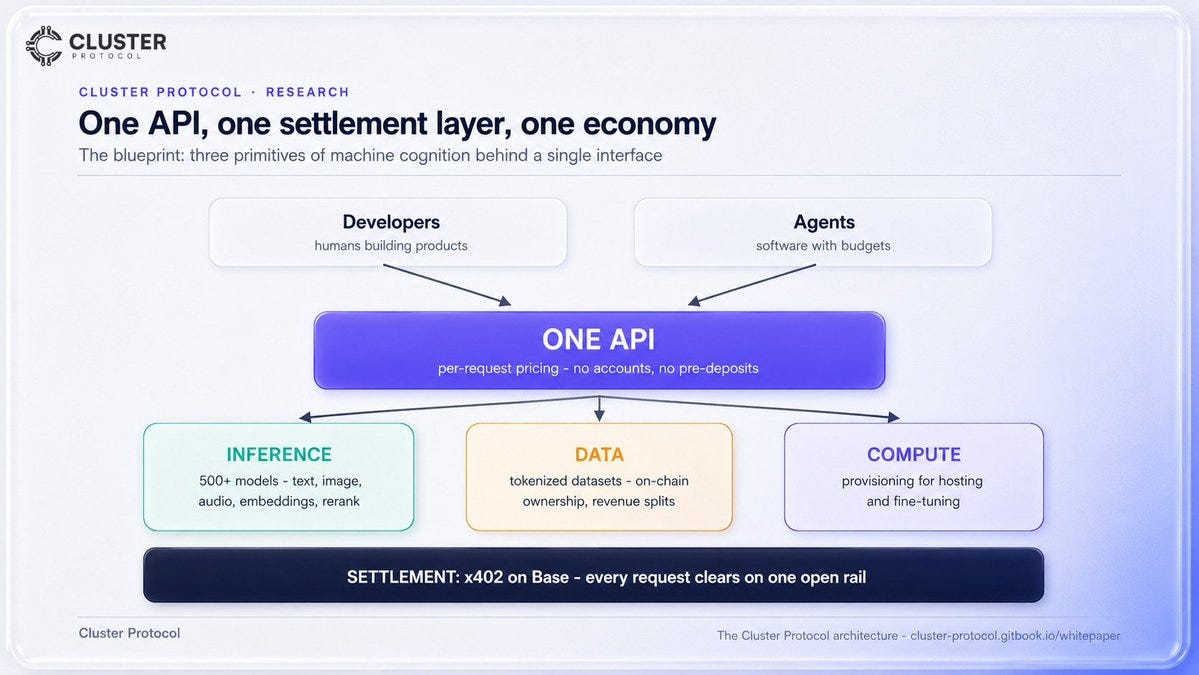
The blueprint, stated plainly: a single orchestration layer where the three primitives of machine cognition, model inference, tokenized data, and compute, sit behind one API, priced per request, settled natively on an open rail.
This is, explicitly, the architecture Cluster Protocol🔗 is built on: an inference gateway spanning 500+ models across modalities; a data marketplace where datasets carry onchain ownership and automatic revenue distribution; compute provisioning for hosting and fine-tuning, unified on Base with x402 settlement, so a human developer or an autonomous agent can buy any of the three with one request and no account. One API to call intelligence. One layer where the money clears. One economy where supply competes for every request.
The deeper argument is about what AI becomes when this layer exists. Electricity became transformative when it became boring: metered, standardized, abstracted from its generators. Computing became ubiquitous when AWS made it rentable by the hour. Intelligence is on the same arc: from artisanal integrations toward a metered utility, bought per request, by anyone and anything.
In 2005, “we should run our own servers” was a defensible engineering position. By 2012, it was a confession of nostalgia. “We hand-integrate our own model, data, and compute stack” is on the same clock, and the AWS of intelligence will look obvious in retrospect, the way every collapsed layer does.
The heavy lifting is undifferentiated. It always was. Someone just has to do it once, behind one API, and meter it.
Sources
- [KuCoin Research: The Great Convergence: AI + Crypto Landscape 2026](https://www.kucoin.com/blog/deep-dive-to-AI-crypto-future)
- [x402.org: Internet-Native Payments Standard](https://www.x402.org/)
- [Chainalysis: Inside x402: 100M Agentic Payments on Base](https://www.chainalysis.com/blog/x402-agentic-payments-adoption/)
- [AWS: x402 and Agentic Commerce](https://aws.amazon.com/blogs/industries/x402-and-agentic-commerce-redefining-autonomous-payments-in-financial-services/)
- [Mean CEO: AI data licensing markets](https://blog.mean.ceo/ai-data-licensing/)